Showing posts with label Book review. Show all posts

Friday, November 1, 2024

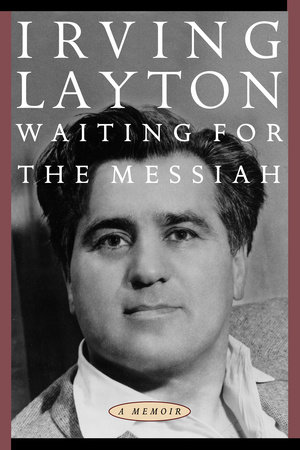
Waiting for the Messiah - a Memoir, Irving Layton with David O'Rourke


Waiting for the Messiah - a Memoir, Irving Layton with David O'Rourke
McClelland and Stewart, 25 Hollinger Road, Toronto
c. 1985. Hardback, 264 pages.
https://images.penguinrandomhouse.com/cover/9780771049521
 

To this reader, it is hard to reconcile the initial chapter of this book with the succeeding ones. Indeed, the further one delves in this memoir the more it appears as though the reader has been made privy to the maturing of a writer. The beginning chapters have a naivete, an arrogance and even a kind of silliness (deliberately playful, let us dare hope) which is off-putting and unworthy of the literary stature of this man, despite his flamboyance and provocative style.

But, for those of you who may decide to embark upon this reading adventure, a word of advice - persevere. It's worth it, for the work steadily improves and becomes less tendentiously tedious (the initial style and content going far to give credence that some people will do anything for attention and that advanced age is no guarantor of social or emotional maturity) and progressively interesting.

Less, alas, as a result of Layton's own life experience, more as a fallout of his place in the times he writes of, and his relationships, close, tenuous, distanced or what-have-you, with other, more interesting, and sometimes more talented people than he.

Which is not to deny the man's estimable talent. I have tried to in the past, mind, when his misanthropic and seemingly misogynist attitudes have infuriated me to the point of denying the man his due - and my adversary-in-opinion has been none other than my husband, an ardent admirer of this latter-day bard - an unhappy experience.

Layton begins his memoir, logically enough, at the beginning. We are informed that the incipient poet was 'born with the smell of baked Challa in his nostrils', a startling revelation but infinitely less so than his other well-known claim, that he was born with the messianic sign - already circumcised. This affectation does not grow dim with the passage of time, but since it offers a kind of comfort to the man there is no point denying him that cushion.

During his growing, and omnivorously-reading years, he imbibed stories of the lives of other saviours and heroes, including Moses, Buddha, Alexander the Great - whose own births were accompanied by bizarre circumstances, as his was. Thus was born a legend of self.

Once departing from that thesis, we are introduced to life in the Lazarovitch family, with father Moishe, a soft-spoken, pious and scholarly man who brought the shtetl with him to Montreal; mother Klara who shrieks curses down upon young Irving's hapless head; siblings Avrum, Dora, Esther, Gertie, Harry, Hyman and Larry. And, of course, the extended family members, most particularly the men whom sisters had wed, and whose foibles and coarseness are discoursed upon at length. Layton's childhood was not a happy one.

In a background of grinding poverty, in a family whose orientation was mercenary (how else survive in the hostile environment for immigrant Jews in turn-of-the-century Montreal?), the emerging intellectualism of the young boy with a mischievous temperament was a puzzle and a nuisance to his family. While Layton was increasingly drawn by education, with an emphasis on literature and the beauty of language, his increasingly alienated family demanded that he assume the life of an itinerant peddler, an occupation at which, fleetingly, given his gregarious character, he was able to succeed very well at.

But Layton had a self-vision of a glory greater than earning dollars with which to support himself, and eventually evolve into budding mercantilism. His love of, and admiration for poetry, was first inspired by the beautifully rendered readings of Tennyson's Ballad of the Revenge by one of the few teachers for whom Layton had some modicum of respect at Baron Byng High School.

In total, Layton's experiences with teachers in general throughout the public school system, and on into college were dismal, demoralizing affairs for the budding scholar/poet. Insensitive clods they were, demineralized, myopic, harsh, coldly demanding and censorious of the high-spiritedness of a rebellious adolescent with a penchant for learning, but only in the environment of nurturance, which was, alas, a scarce commodity.

He had a budding romance, both with a young woman (and by extension, her mother) and with the dialectic of communism. With the former because he was a normal, lustily yearning young male, the latter because it was socially verboten. After that flirtation, Layton dabbled, with friends who drew him into their circle, with socialist ideals. He met, and became a personal friend of David Lewis whose analytical and brilliant mind he appreciated, but whose oratory he felt was far from brilliant. Through Lewis he met Abraham Klein, then a young articling lawyer, and language-precise, fiery poet with whose help he was able to master Latin, and make his senior grades.

A chance encounter led him to attend college, at a time when Layton was drifting along, with nothing much else to do but earn the odd dollar to keep a roof over his head and go to meetings at the Young Peoples' Socialist League communist meetings, and Horn's Cafeteria, the hangout for social radicals of the time where social responsibility, proletarians' rights, Marx and Engels, the Communist Manifesto, the evils of the capitalist class, unions and labour were discussed with resounding vigour, and the pilpul of opinion had its day.

In that forum Layton was exposed to the explosive mixture of socialist and communist thought, Trotskyism, anarchism. It was a heady, pleasing ongoing experience for the young man, which he balanced with his private readings of Shelley and Keats, trying to hone his own, by then, not inconsiderable skills, both as an orator, and a poet. Very little of the social cant, of the traditional exposition to which he was exposed was taken at face value; he observed and trod daintily among the ideals and ideas, although his admiration for some of the exponents knew no bounds.

This was the Quebec of the Catholic Church with its stranglehold on the thoughts and minds of Quebecois; it was the Quebec of Arcand, and of police brutality. And this was a Layton whose mind and heart were torn between social activism and literary endeavour. In the end, his literary ambitions emerged victorious, although there is an inescapable thread of social activism in the warp and woof of his literary work.

The college of Layton's choice turned out to be Macdonald College, chosen for the logical reason that it was the only institute of higher learning which he could manage to afford. Associated with McGill University, the only degree this college conferred was that of Agriculture and this explains neatly why Layton's degree is in this area.

Because of the cautious, conservative, intellectually stilted atmosphere of the college, Layton decided that he would form a speakers' club which he called the Social Research Club. To its regular meetings he invited the then-president of the Royal Bank of Canada, followed in fairly rapid succession by the pacifist Lavell Smith, the fabled Dr. Normal Bethune, and the founder of the CCF, J.S. Woodsworth. His plans to also invite Tim Buck were thwarted by the organized efforts of other members of the student body who feared the college would be irremediably tainted red, thus scuttling their future plans for a civil service career.

Layton experienced a great deal of satisfaction in knowing that exposure to these fiery speakers of the time, some of them exceedingly controversial, opened up the minds of their student listeners. Even so, the reputation that Layton acquired while at the college was not that of a social facilitator, but that of a rabble rouser, and both the unlikely appellations of 'Hitler' and 'Trotsky' often crowned his reputation there.

Layton mourned the sad fact that while at college the literary-poetic idols held to review and admiration were those of the era of Edwardian England, and as delightful and earth-shaking at their time as they were, they did not reflect the social and cultural tradition of the country and the times which he inhabited. He professes to some bitterness at not having been exposed to the works of T.S. Eliot, Hart Crane, and Walt Whitman, let alone Canadian poets like Lampman, Bliss Carman or E.J. Pratt.

This lack left him with the impression for too long, he felt, that he could do no better than to emulate their style. It was when he became exposed through his own search and pique to the work of these ground-breakers that it dawned upon him what progressive poetry, free verse reflecting the temper of the times could really accomplish.

The man, obsessed with the earthiness of life, of passions unleashed, scorning convention and the limpid and sexually repressed poetic style of his peers, evolved a poetic address uniquely his own. One that shocked both the reading public and the then-literary establishment. It was not 'polite'.

He writes of his marriages, of his attachment to women, to his ideas and his poetry. He writes of the joy and ecstasy of creative achievement, of self-affirmation in the final realization that one is yes indeed, a poet of incalculable creative ability. Which there is no denying Irving Layton is.

This is a good book, a rewarding book, and in its own way, a revelation, Messiah complex aside. For in his very own, inimitable way, Layton really has been a messiah; he has helped to unleash unbridled sensualism in poetic expression, given it a fire of his own devising, and brought poetry where it belongs, in the gut as well as the mind of the reader.

Abrasive and even abusive he can be at times, but where is there a poet whose totality is perfection? It is unfortunate that Layton's very well-publicized divergence of opinion with Elspeth Cameron and his dismissal of her 'unauthorized' biography of him did not result in an increased public interest in his own book. One has the impression that the increased notoriety he might have traded upon as a result of the acrimonious exchanges in the media would translate itself in brisk sales, but alas, volume one of his memoirs has not sold well.

Still, he's preparing to write the second volume of Waiting for the Messiah and this reviewer, however inclined to be critical as I am, intends to wait for that messiah. Stay tuned.


Monday, October 28, 2024

War Criminal on Trial - The Rauca Case

https://encrypted-tbn2.gstatic.com/images?q=tbn:ANd9GcRyQMSYJh80dteYQ7MXasxDC7uKJAMkejFyKu5CTPmb733cIYGz

War Criminal on Trial - The Rauca Case
by Sol Littman, Lster & Orpen Denys Limited,
Toronto, c.1983, 195 pp., $17.94

This book, by Toronto journalist and community affairs specialist for CBC's Newshour, Sol Littman, was born out of a collection of articles originally produced by the author for publication in Saturday Night magazine. The book is dedicated:

"To the courageous Jews of the Kaunas ghetto - the few who survived and the many who were slain."

In a sense, this book is their story; that of the Jews who lived throughout the Nazi years in all of the Nazi-occupied countries of Europe. Mr. Littman has documented his book thoroughly, travelling extensively to interview survivors of the Kaunas ghetto in Israel and elsewhere. This is a book well worth reading. What one reads here of the horrific impossibility of existence as a Jewish adult, child or octogenarian is a reflection of what occurred elsewhere in Europe from 1939 to 1945. Survival of a handful of Europe's Jewry, under the obscene conditions which existed for them, was nothing less than miraculous.

That such unbelievable conditions could occur anywhere on this Earth, singling out any specific group of people is the horror of our time. That the perpetrators and indeed the initiators of many of the atrocities described in this book, as in many others, would themselves survive - time and justice - and indeed, thrive in their newfound homelands, be they cities in Canada or somewhere in South America is just as unbelievable as the crimes they committed against humanity.

Mt. Littman points out at the conclusion of his book (chapter 17), that there are currently over one thousand Nazi collaborators living in Canada. Over the past decades there have been over one hundred requests for extradition of alleged war criminals from such democratic Western countries as France, Holland, Belgium, Norway and Germany received by Canadian authorities. Additional extradition requests have been received in Canada from Eastern Bloc countries, all of which wish to bring these criminals to justice. Canada has a policy of unwillingness to comply with such requests from Iron Curtain countries; there is a certain sensitivity toward these alleged war criminals - we would not, as civilized, democratic people, wish to return them to communist countries, would we? Heaven knows, they might be found guilty and punished for their imputed crimes.

Needless to say, Canada has not been diligent in responding to requests from the Western democratic countries, any more than she had to Iron Curtain countries. The Rauca case marked the first time Canada actually moved itself to accede to such a request.

Through this book we are taken on a journey. We are first introduced to Helmut Rauca, Canadian senior citizen and respected member of his suburban Toronto community, when three members of the RCMP politely arrest the then-73-year-old German-born man. Taken into custody at RCMP regional headquarters in downtown Toronto, Rauca is fingerprinted, photographed, and appears before Associate Chief Justice William Parker of the Supreme Court of Ontario, to be charged. He is taken then to the Toronto Don Jail after his arrest, charged with "aiding and abetting the murder of 10,500 persons on or about the 28th day of October, 1941, at Kaunas, Lithuania."

Albert Helmut Rauca was part of an SS security unit termed "Einsatzgruppe", stationed in Kaunas from July 1941 to July of 1944. He was an SS master sergeant and member of the command headquarters of the Security Police and the SS Security Service for the General District of Lithuania. Rauca was proud of his position with the SS. He was feared and despised by the inmates of the Kaunas ghetto; well known to them all for his predilection for unpredictable and violent action.

Much as was done in other large European cities under German occupation, the capital city of Kaunas, through its civil administration under the Nazis, collected its Jewish population in a small geographic area set aside for that purpose as a collection point; a place where the Jewish men, women and children could be held, apart from the general population, and the young and strong could be used for slave labour while gradually culling the old, the ill and the very young through Aktionen whereby firstly the young intellectual males were collected under the pretext of an offer of 'good jobs', and taken instead to a nearby fort and murdered.

This select group was culled initially because it was feared that insurrection or insubordination might be initiated from among their ranks. Next came a round-up of the children of the ghetto where stormtroopers and eagerly helpful Lithuanians rooted out children of all ages wherever they had been hidden so that they too might be taken to one of the forts surrounding the capital city and summarily executed.

The third (and near final) roundup, termed the 'Grosse Aktion', was one in which all the inhabitants of the ghetto were commanded to appear at a central meeting place and at that time, Rauca busied himself separating the people who appeared before him in turn; singly and in family groupings they were separated into groups of those who were still desirable as slave labour, and those who were more immediately expendable. An indication to join those grouped on the right was a death sentence, an order to join those assembled to the left meant a brief respite at least until weary, starved bodies could no longer be pushed to produce and they too would be eliminated.

This scenario was repeated in many other ghettos, with others, among them the infamous Dr. Josef Mengele, playing the role of god, choosing those who would die more immediately than others.

The Judenrat in Kaunas was, however, quite different than that which existed in most other ghettos of the time. Its head, a highly respected elderly physician who spared no efforts at attempting to save his people, was Dr. Eichanan Elkes. Dr. Elkes' desperate attempts to persuade the Lithuanian civil authority (many of whom had been former colleagues and brother military officers) to relent in their acquiescent prosecution of Nazi directives, and his unflinching accusations, face-to-face, directed at the Nazi officers that they would one day 'pay' for their horrible crimes place him in a different sphere altogether.

Similarly, the other members of the Altestenrat (Council of Elders) conspired, not with the Nazis to save their own skins, but actively against them. Also in Kaunas the Jewish ghetto police, that group of Jewish men who in other ghettos acted more as Nazi collaborators than Jews, were vastly different under Dr. Elkes and his Council. Proud young Jewish men who had been responsible youth leaders, athletes and intellectuals were chosen and this group of ghetto policemen collaborated with their own, many of them also being active in the ghetto underground.

This book details their daily living conditions, their ferocious fears of their short-lived futures, and the gruelling work to which they were submitted, to survive. The horrors experienced by the ghetto during the various roundups, and in the final trial through the burning of the ghetto are unforgettably re-lived here.

If anyone, pacifist-forgiving Jew, or uncomprehendingly removed Gentile, might ever be assailed by a sense of misgiving about the rightfulness of pressing for prosecution of war criminals at however much a distance in time 1984 represents, this book should be required reading.

The performance of the government of Canada, aside from the honourable performance of a few of its servants like Corporal Fred Yetter of the RCMP, and Christopher Amerasinghe who acted as crown prosecutor for the Attorney-General of Canada, is appalling, dismal and totally uncreditworthy. With a little bit of diligence, Rauca's records in Germany might have been perused and his entry to Canada would have been denied initially, back in the 50s. But reality is that the Government of Canada was far more anxious throughout the 30s, 40s and 50s to keep European Jews out of Canada than it was any other European nationals.

Our country has much to answer for, but it continues to appear as though this represents simply another incident to be buried, and lip-service will continue to be paid to human rights while the actuality of actively pursuing those goals are but a dream.

An end-quote from Dr. Emil Fackenheim of the University of Toronto appears most apt at the conclusion of this book. When asked why Jews cannot 'forgive and forget' (an infuriatingly impossible question), Dr. Fackenheim replies: "It is not out of revenge that we demand the prosecution of war criminals, but out of a sense of universal justice. The Holocaust was a tragedy inflicted on the Jews, but it was also an act of pure evil that affects all mankind." No more need be said.


Sunday, October 27, 2024

The Burning Bush: Poems and Other Writings (1940-1980) by Aaron Kramer, Cornwall Books, 1982

 https://m.media-amazon.com/images/I/41rZftDTVeL._SL200_.jpg

The Burning Bush: Poems and Other Writings (1940-1980)
by Aaron Kramer, Cornwall Books, 1982

This collection by the American academic, translator and poet, Aaron Kramer, The burning Bush, represents, as his long-time friend and publisher Thomas Yoseloff tells us in his introduction, a "highly subjective" group of poems, "to represent the essence of his forty years of literary output". And, as was the intent in this careful selection, the reader does "come away with a thorough understanding of the essence of the poet's oeuvre".

An understanding, moreover, which leads one to marvel at the sensitivity of Dr. Kramer's perceptions, his intense and burning interest in all which surrounds him, his ability to evoke, through a careful selection of impressions - Everyman. And yet, although he too is Everyman through his detailing of a life - his life - he is yet unique, not only in the way that we all are as distinct personalities shaped by genetic endowment and environment - but this is a scintillating soul which compels us, after reading one group of poems, to go on reading, discovering, and admiring the essence of this person whose legacy to the world is this special creative talent.

The Burning Bush is both reality and metaphor. Dr. Kramer's cultural/historical roots shape his sensitivities and his ability to discern, to cull the precious element from what might appear to be the pedestrian; dross of anyone's existence in a way that celebrates life, in a manner that, in the true creative mind, sings of the glory of life. He is aware of the dark side of life, of human nature, of history. Never forgetting that he still is able to gently move aside the curtain of despair, the cushion of apathy, and find that precious spark in every situation, in any person; surely we all have the potential to perceive, to appreciate as he does?

Many of these poems were published in his previous nine collections. these are poems of joy, of longing, of bitter regret, of fond memory and of despair too in the knowledge that time is such an inexorable and ineffable element; and too little of it is apportioned to each one of us. But there is also present in this collection humour and whimsy and a deep and abiding love. The love of a son for his father, his mother and later, as a motherless young boy, for the sister who would try to mother him.

In the segment titled Family: 1 - the poet speaks of a story his mother would tell him to encourage him to eat, as a child. In A Lunch Remembered, the mother croons a story: "Once, in a forest a mother bird/sang while her babies sat sleeping/Hushabye fledglings! At dawn you fly/over the deep wide waters./Alone I'll die,/but hushabye;/you'll live, sweet sons and daughters..." And the child then asks: "Did they live? The story's finished/Did she die? Eat up the spinach!/What's the matter. Ma? You're crying!"

So it's little wonder that the child grown to a man could write such poems as The Song of the Burning Bush. "It blazes wild, this bush of woe-/not water speaks to its need, nor wine;/only weeping and blood - there grow/such furious berries, that all who dine/go screaming and dreaming over the seas,/seeking an altar for their knees." And this man did, as he promised in that poem, "tear the testaments out of my soul". The poems are his testament. His avowal of a life realized, well lived.

In the group of poems included in The Holocaust selection he writes in The rising in the Warsaw Ghetto: "If a word from Warsaw came,/unsurprised we took the news;/April's sun had set aflame/fifty thousand ashlike Jews". Briefly holding aloft the flame of life, those ashlike Jews affirmed their right and although might briefly triumphed leaving them in a funeral pyre of immense proportions, their actions, their affirmation still lives through the burning lines of a poet.
In the poem Tour, he tells us:
In four languages, the guide
explains as she has twice a day for years,
that we are entering
one of the quaintest sections of the city,
formerly the Jewish quarter.
Inside the synagogue she points out oddities.
'Notice the walls!'
Perfectly arrayed, as if being marched
are names -
seventy thousand Czechoslovak Jews,
their dates of birth and deportation.
"A touch on the shoulder/'Must you always be the last one/back on the bus?" he is asked, when he feels immersed in the memory of his immense black experience which he feels in his very marrow, as though it had happened to him; a brother Jew, knowing it had happened to him, and will continue to be a part of a Jew's experience, his life.

This man, this poet, this son, father, lover, husband, considers himself a fortunate man. Fortunate in the love lavished upon him by a father and mother who cherished their children; fortunate in his memories of them, in his memories of his own children growing up, thriving, in his companionship with his wife. He calls himself, in poems, Mr. Lucky, Mr. Glucklich. In the poem Mr. Glucklich Takes a Shower, we are given an instant history of the fondness of the human memory, as, under the shower which becomes "a world that has only water":
He is thirty-four, circling Lake Garde,
guzzling in his thirst its Giorno blue;
he is twenty-four, wheeling his baby
up to the fountain in Washington Square;
he is fourteen, repaying spray with madrigals
the length of Gravesend Bay;
he is four, above the shadowy Hudson,
on a mountainside across from Newburgh,
joining his mouth to the nipple of a spring;
he is the first breather ever cradled by the sea;
he is the sea god.
Dr. Kramer writes a universal experience, in an exquisite language of understanding. Hindsight is something we are all gifted with, but more, so many of us have experiences which, although we perceive them as being unique to ourselves are but repetitions of limitless human experience; they repeat themselves generation after generation. In Hindsight we are thusly informed:
You kept us safe, you kept us soft,
you trembled when we sneezed or coughed;
you gave your life for our life's sake -
no doubt it was a grave mistake:
but it was a mistake of love
which we are also guilty of.
Our children also figure out
what we are whispering about.
To keep them soft, we too grow hard;
to keep them safe, we too are scarred.
And through our love for them, we see
your love's true shape and quality.
To have been able to read this collection represents an experience of recognition. There is a sublime beauty in the strength of so many of these poems. No man could wish a finer epitaph to leave as a reminder of his own life and experience, and the richness of both. To evoke in the reader the sense of kinship, of empathetic recollection is no mean feat.

Some poems, such as those comprising the first half of Minotaur, although certainly not lacking in conviction, do not, however, quite manage to persuade this reader; there's almost a lack of intensity of experience itself ... a perception which is lifted in the second half of Minotaur when one no longer feels a distanced onlooker, but is once more taken by the poet into the inner circle of experience.

This is a diversified group of poems, to which the reader can only respond with a sense approaching love for a stranger, the writer of these poems, who happens in the end to be no stranger at all.


Saturday, October 26, 2024

The Blue Pools of Paradise

https://pictures.abebooks.com/isbn/9780919926264-us.jpg
by Mick Burrs, Coteau Books, c.1983
Thunder Creek Publishing co-Operative Limited

The author, a transplanted American draft-evader now living in Regina, is a poet and a teacher of creative writing. Mr. Burrs, beside being the founder of a reading series, is also a vocal advocate of books written by Saskatchewan writers.

In this collection Mr. Burrs has turned to exploration as a way of mining his inner feelings, as a way to attempt to understand his beginnings and perhaps by so doing, understand also the endings of all things. For the human experience is a universal one; understand what brought us to the shore of sentience and the universe is unravelled before us. This search is a long and weary one, the road a well-traversed one, well-worn by many who have gone before - and the exploration is doubtless destined to be repeated by those many who will surely come after. The answers are elusive, the way is shrouded in mystery, a mystery as arcane and little-fathomed as the human mind and the emotions which experience evoke. The search for sources, the search to unravel mysteries beckons many, and some who search discover truth. But truth is a troublesome word and what is truth or 'answer' to some is merely baffling and veiled mystique to others.

Perhaps real truth lies in the satisfaction of having attempted the journey; to finally understand is not given to many, and many realize that behind one truth or one answer is simply another question beckoning, another exploration to be undertaken and its mystery unravelled.

Mick Burrs begins his exploration through his family's unrecorded history, back to the tracery of Czarist Russia, pogroms, the differences of Yiddishkeit, the ostracism of the 'different folk'. Aptly enough, the photograph fore and aft of this collection does speak a thousand words, silently and eloquently, as it is a photograph of Russian military officers sitting around a table hosting a Samovar and the lead poem, titled 'Samovar', sets the exclusionary stage at which the story told through the collected poems, unfolds.

Mr. Burrs dangles exploratory fingers into the pudding of his birth, to his early development, when in a poem with that title he "...would laugh and swing/ eight years old/ a pilot taking wing/ in our garden/ shout BOMBS OVER TOKYO!' on a swinging crescent/ a boy/ too young to know/ bombs/ are appalling things/ tokyo a human place/ i only now remember/ our japanese gardener/ hoeing, turn away his face/".

The poet lingers over 'names and numbers', tracing his connection to father, grandfather and name change from "B ... is for Burrs, from Berzinsky/ (son of one who lives near Birches),/ his family name/ ...the family name changed/ by the father, in the New World,/ to fit in with the Smiths,/ to be more acceptable to the Browns/" ... with the poet's avowal of the value of the Berzinsky, yet his devotion to the Burr, now long-familiar and self-owned.

From the purges and the pogroms, from the Czarist officers and their samovars - escape - to the Goldene Medina. Transition to the golden world of Encino, California, where the neighbourhood has changed, and the samovar transformed to swimming pools; the fabled blue pools of paradise. Surrounded by movie stars, palatial homes and the obligatory pool, the neighbours are felt, but never seen; forever diving into their pools, celebrating, bringing in New Years' fetes. The separatedness, the apartness of the Burrs family is as complete in this new world as it was in the old.

Finally, an act of separation, the decision of the misunderstood, unappreciated and sensitive son to leave the country of his family's succour, that country which has oppressed another, alien people. His refusal to fight, his flight to another, war-uninvolved country which brings him to the following poem, after an evening in a Vancouver hotel room with his father and mother, where their two disparate sensibilities and worlds still fail to touch one another; neither father nor son saying the things that matter, to bridge the gap of misunderstanding, and soon afterward, on his return to Encino, the father dies:

"And none of us realized that last night
in the motel room in Vancouver
how one year later
these two Als
my father the sign painter and real estate broker
Jolson the movie star and popular singer
would share
the same consecrated hillside
of the City of Angels
each with his place under the grass
(though they had never met
on the palm tree boulevards of Encino)
or how their gray hair
would slowly intertwine
with the holy roots in the dark
soil of Hollywood
(Near the oil derricks and bright roar
of the city's snarling freeways)
or how the audience of their bones
would only hear the stillness
of talk / the silence of song
from a million flickering stars
light years removed from all those fabled blue pools
of paradise."


Mr. Burrs returns, briefly, to Russia/California to bid farewell to his dying grandfather... "I had not seen you for fourteen years./ Now at the gray border separating our lives/ the bus driver turned the motor off -/ and I watched an officer step aboard." He is taken off the bus, interrogated, and is relieved to be permitted his journey. He tries to explain ...
"You could not understand why your grandson
had fled the country that was your refuge,
had left the land of freedom; to be free,
not to struggle in someone else's war,
not to kill or be killed, but to find

the gift of poetry
along paths in northern woods,
songs waiting to drop like red berries
from the arms of snow-clad trees."

Finally, he recalls himself as a nature-struck child, collecting fireflies, wondering at the effervescent, evanescent firefly in a jar ... and it is this wonderment that we shall all, perhaps, return to finally... "Discovered among songless shadows/ plucking my notes of fire/ on invisible strings/ I became/ your small captured moon/ composed of throbbing light/ the one bright song/ in your dark universe/ now I resonate with echoing faintly against glass."

In the final analysis, we are all but transient flashes, fireflies burning brightly, then extinguished. But while we burn, beating our wings against adversity, striving to live out our ephemeral spans with dignity and honour we search for direction and meaning. Sometimes we discover these in our personal histories.

This collection does justice to the never-ending search.

c. 1985 Rita Rosenfeld
published in Canadian Jew

Tuesday, September 3, 2024

The Burning Bush: Poems and Other Writings (1940-1980)

https://www.oneforisrael.org/wp-content/uploads/2023/04/Depositphotos_640984348_XL-scaled-e1682839745111.jpg

The Burning Bush: Poems and Other Writings (1940-1980)
by Aaron Kramer, Cornwall Books, 1982

This collection by the American academic, translator and poet, Aaron Kramer, The Burning Bush, represents, as his long-time friend and publisher Thomas Yoseloff tells us in his introduction, a "highly subjective" group of poems, "to represent the essence of his forty years of literary output". And, as was the intent in this careful selection, the reader does "come away with a thorough understanding of the essence of the poet's oeuvre".

An understanding, moreover, which leads one to marvel at the sensitivity of Dr. Kramer's perceptions, his intense and burning interest in all which surrounds him, his ability to evoke, through a careful selection of impressions - Everyman. And yet, although he too is Everyman through his detailing of a life - his life - he is yet unique, not only in the way that we all are as distinct personalities shaped by genetic endowment and environment - but this is a scintillating soul which compels us, after reading one group of poems, to go on reading, discovering, and admiring the essence of this person whose legacy to the world is this special creative talent.

The Burning Bush is both reality and metaphor. Dr. Kramer's cultural/historical roots shape his sensitivities and his ability to discern, to cull the precious element from what might appear to be the pedestrian; dross of anyone's existence in a way that celebrates life, in a manner that, in the true creative mind, sings of the glory of life. He is aware of the dark side of life, of human nature, of history. Never forgetting that he still is able to gently move aside the curtain of despair, the cushion of apathy, and find that precious spark in every situation, in any person; surely we all have the potential to perceive, to appreciate as he does?

Many of these poems were published in his previous nine collections. these are poems of joy, of longing, of bitter regret, of fond memory and of despair too in the knowledge that time is such an inexorable and ineffable element; and too little of it is apportioned to each one of us. But there is also present in this collection humour and whimsy and a deep and abiding love. The love of a son for his father, his mother and later, as a motherless young boy, for the sister who would try to mother him.

In the segment titled Family: 1 - the poet speaks of a story his mother would tell him to encourage him to eat, as a child. In A Lunch Remembered, the mother croons a story: "Once, in a forest a mother bird/sang while her babies sat sleeping/Hushabye fledglings! At dawn you fly/over the deep wide waters./Alone I'll die,/but hushabye;/you'll live, sweet sons and daughters..." And the child then asks: "Did they live? The story's finished/Did she die? Eat up the spinach!/What's the matter. Ma? You're crying!"

So it's little wonder that the child grown to a man could write such poems as The Song of the Burning Bush. "It blazes wild, this bush of woe-/not water speaks to its need, nor wine;/only weeping and blood - there grow/such furious berries, that all who dine/go screaming and dreaming over the seas,/seeking an altar for their knees." And this man did, as he promised in that poem, "tear the testaments out of my soul". The poems are his testament. His avowal of a life realized, well lived.

In the group of poems included in The Holocaust selection he writes in The rising in the Warsaw Ghetto: "If a word from Warsaw came,/unsurprised we took the news;/April's sun had set aflame/fifty thousand ashlike Jews". Briefly holding aloft the flame of life, those ashlike Jews affirmed their right and although might briefly triumphed leaving them in a funeral pyre of immense proportions, their actions, their affirmation still lives through the burning lines of a poet.

In the poem Tour, he tells us:
In four languages, the guide
explains as she has twice a day for years,
that we are entering
one of the quaintest sections of the city,
formerly the Jewish quarter.
Inside the synagogue she points out oddities.
'Notice the walls!'
Perfectly arrayed, as if being marched
are names -
seventy thousand Czechoslovak Jews,
their dates of birth and deportation.
"A touch on the shoulder/'Must you always be the last one/back on the bus?" he is asked, when he feels immersed in the memory of his immense black experience which he feels in his very marrow, as though it had happened to him; a brother Jew, knowing it had happened to him, and will continue to be a part of a Jew's experience, his life.

This man, this poet, this son, father, lover, husband, considers himself a fortunate man. Fortunate in the love lavished upon him by a father and mother who cherished their children; fortunate in his memories of them, in his memories of his own children growing up, thriving, in his companionship with his wife. He calls himself, in poems, Mr. Lucky, Mr. Glucklich. In the poem Mr. Glucklich Takes a Shower, we are given an instant history of the fondness of the human memory, as, under the shower which becomes "a world that has only water":
He is thirty-four, circling Lake Garde,
guzzling in his thirst its Giorno blue;
he is twenty-four, wheeling his baby
up to the fountain in Washington Square;
he is fourteen, repaying spray with madrigals
the length of Gravesend Bay;
he is four, above the shadowy Hudson,
on a mountainside across from Newburgh,
joining his mouth to the nipple of a spring;
he is the first breather ever cradled by the sea;
he is the sea god.
Dr. Kramer writes a universal experience, in an exquisite language of understanding. Hindsight is something we are all gifted with, but more, so many of us have experiences which, although we perceive them as being unique to ourselves are but repetitions of limitless human experience; they repeat themselves generation after generation. In Hindsight we are thusly informed:
You kept us safe, you kept us soft,
you trembled when we sneezed or coughed;
you gave your life for our life's sake -
no doubt it was a grave mistake:
but it was a mistake of love
which we are also guilty of.
Our children also figure out
what we are whispering about.
To keep them soft, we too grow hard;
to keep them safe, we too are scarred.
And through our love for them, we see
your love's true shape and quality.

To have been able to read this collection represents an experience of recognition. There is a sublime beauty in the strength of so many of these poems. No man could wish a finer epitaph to leave as a reminder of his own life and experience, and the richness of both. To evoke in the reader the sense of kinship, of empathetic recollection is no mean feat.

Some poems, such as those comprising the first half of Minotaur, although certainly not lacking in conviction, do not, however, quite manage to persuade this reader; there's almost a lack of intensity of experience itself ... a perception which is lifted in the second half of Minotaur when one no longer feels a distanced onlooker, but is once more taken by the poet into the inner circle of experience.

This is a diversified group of poems, to which the reader can only respond with a sense approaching love for a stranger, the writer of these poems, who happens in the end to be no stranger at all.


Monday, August 19, 2024

War Criminal on Trial - The Rauca Case

https://i.cbc.ca/1.2043338.1544810171!/httpImage/image.jpg_gen/derivatives/16x9_780/li-620-gavel-is3118029.jpg
War Criminal on Trial - The Rauca Case
by Sol Littman, Lester & Orpen Denys Limited,
Toronto, c.1983, 195 pp., $17.94

This book, by Toronto journalist and community affairs specialist for CBC's Newshour, Sol Littman, was born out of a collection of articles originally produced by the author for publication in Saturday Night magazine. The book is dedicated:

"To the courageous Jews of the Kaunas ghetto - the few who survived and the many who were slain."
In a sense, this book is their story; that of the Jews who lived throughout the Nazi years in all of the Nazi-occupied countries of Europe. Mr. Littman has documented his book thoroughly, travelling extensively to interview survivors of the Kaunas ghetto in Israel and elsewhere. This is a book well worth reading. What one reads here of the horrific impossibility of existence as a Jewish adult, child or octogenarian is a reflection of what occurred elsewhere in Europe from 1939 to 1945. Survival of a handful of Europe's Jewry, under the obscene conditions which existed for them, was nothing less than miraculous.

That such unbelievable conditions could occur anywhere on this Earth, singling out any specific group of people is the horror of our time. That the perpetrators and indeed the initiators of many of the atrocities described in this book, as in many others, would themselves survive - time and justice - and indeed, thrive in their newfound homelands, be they cities in Canada or somewhere in South America, is just as unbelievable as the crimes that they committed against humanity.

Mt. Littman points out at the conclusion of his book (chapter 17), that there are currently over one thousand Nazi collaborators living in Canada. Over the past decades there have been over one hundred requests for extradition of alleged war criminals from such democratic Western countries as France, Holland, Belgium, Norway and Germany, received by Canadian authorities. Additional extradition requests have been received in Canada from Eastern Bloc countries, all of which wish to bring these criminals to justice. Canada has a policy of unwillingness to comply with such requests from Iron Curtain countries; there is a certain sensitivity toward these alleged war criminals - we would not, as civilized, democratic people, wish to return them to communist countries, would we? Heaven knows, they might be found guilty and punished for their imputed crimes.

Needless to say, Canada has not been diligent in responding to requests from the Western democratic countries, any more than she had to Iron Curtain countries. The Rauca case marked the first time Canada actually moved itself to accede to such a request.

Through this book we are taken on a journey. We are first introduced to Helmut Rauca, Canadian senior citizen and respected member of his suburban Toronto community, when three members of the RCMP politely arrest the then-73-year-old German-born man. Taken into custody at RCMP regional headquarters in downtown Toronto, Rauca is fingerprinted, photographed, and appears before Associate Chief Justice William Parker of the Supreme Court of Ontario, to be charged. He is taken then to the Toronto Don Jail after his arrest, charged with "aiding and abetting the murder of 10,500 persons on or about the 28th day of October, 1941, at Kaunas, Lithuania."

Albert Helmut Rauca was part of an SS security unit termed "Einsatzgruppe", stationed in Kaunas from July 1941 to July of 1944. He was an SS master sergeant and member of the command headquarters of the Security Police and the SS Security Service for the General District of Lithuania. Rauca was proud of his position with the SS. He was feared and despised by the inmates of the Kaunas ghetto; well known to them all for his predilection for unpredictable and violent action.

Much as was done in other large European cities under German occupation, the capital city of Kaunas, through its civil administration under the Nazis, collected its Jewish population in a small geographic area set aside for that purpose as a collection point; a place where the Jewish men, women and children could be held, apart from the general population, and the young and strong could be used for slave labour while gradually culling the old, the ill and the very young through Aktionen whereby firstly the young intellectual males were collected under the pretext of an offer of 'good jobs', and taken instead to a nearby fort and murdered.

This select group was culled initially because it was feared that insurrection or insubordination might be initiated from among their ranks. Next came a round-up of the children of the ghetto where stormtroopers and eagerly helpful Lithuanians rooted out children of all ages wherever they had been hidden so that they too might be taken to one of the forts surrounding the capital city and summarily executed.

The third (and near final) roundup, termed the 'Grosse Aktion', was one in which all the inhabitants of the ghetto were commanded to appear at a central meeting place and at that time, Rauca busied himself separating the people who appeared before him in turn; singly and in family groupings they were separated into groups of those who were still desirable as slave labour, and those who were more immediately expendable. An indication to join those grouped on the right was a death sentence, an order to join those assembled to the left meant a brief respite at least until weary, starved bodies could no longer be pushed to produce and they too would be eliminated.

This scenario was repeated in many other ghettos, with others, among them the infamous Dr. Josef Mengele, playing the role of god, choosing those who would die more immediately than others.

The Judenrat in Kaunas was, however, quite different than that which existed in most other ghettos of the time. Its head, a highly respected elderly physician who spared no efforts at attempting to save his people, was Dr. Eichanan Elkes. Dr. Elkes' desperate attempts to persuade the Lithuanian civil authority (many of whom had been former colleagues and brother military officers) to relent in their acquiescent prosecution of Nazi directives, and his unflinching accusations, face-to-face, directed at the Nazi officers that they would one day 'pay' for their horrible crimes place him in a different sphere altogether.

Similarly, the other members of the Altestenrat (Council of Elders) conspired, not with the Nazis to save their own skins, but actively against them. Also in Kaunas the Jewish ghetto police, that group of Jewish men who in other ghettos acted more as Nazi collaborators than Jews, were vastly different under Dr. Elkes and his Council. Proud young Jewish men who had been responsible youth leaders, athletes and intellectuals were chosen and this group of ghetto policemen collaborated with their own, many of them also being active in the ghetto underground.

This book details their daily living conditions, their ferocious fears of their short-lived futures, and the gruelling work to which they were submitted, to survive. The horrors experienced by the ghetto during the various roundups, and in the final trial through the burning of the ghetto are unforgettably re-lived here.

If anyone, pacifist-forgiving Jew, or uncomprehendingly removed Gentile, might ever be assailed by a sense of misgiving about the rightfulness of pressing for prosecution of war criminals at however much a distance in time 1984 represents, this book should be required reading.

The performance of the government of Canada, aside from the honourable performance of a few of its servants like Corporal Fred Yetter of the RCMP, and Christopher Amerasinghe who acted as crown prosecutor for the Attorney-General of Canada, is appalling, dismal and totally uncreditworthy. With a little bit of diligence, Rauca's records in Germany might have been perused and his entry to Canada would have been denied initially, back in the 50s. But reality is that the Government of Canada was far more anxious throughout the 30s, 40s and 50s to keep European Jews out of Canada than it was any other European nationals.

Our country has much to answer for, but it continues to appear as though this represents simply another incident to be buried, and lip-service will continue to be paid to human rights while the actuality of actively pursuing those goals are but a dream.

An end-quote from Dr. Emil Fackenheim of the University of Toronto appears most apt at the conclusion of this book. When asked why Jews cannot 'forgive and forget' (an infuriatingly impossible question), Dr. Fackenheim replies: "It is not out of revenge that we demand the prosecution of war criminals, but out of a sense of universal justice. The Holocaust was a tragedy inflicted on the Jews, but it was also an act of pure evil that affects all mankind." No more need be said.

c. 1985 Rita Rosenfeld
published in Canadian Jewish Outlook, Volume 23, No.1-2

Saturday, August 17, 2024

Portrait of a Writer

16.3: Adele Wiseman

 
Memoirs of a Book Molesting Childhood and Other Essays
Adele Wiseman
Oxford University Press, Toronto. c 1987
Paperback 200 pps. Price $13.95

This is an impressive collection of essays by one of the grande dames of Canadian letters, a literary coeval of Margaret Laurence; indeed, their writing careers paralleled each other's, and theirs has been a long and warm friendship. Although Ms. Wiseman has never quite been recognized as having the same literary stature as her friend, her talents are formidable - as a writer demonstrating the ability to etch sharp images with the added cachet of indelible wit as is readily evidenced by the mischievous sparkle and delicate tracery of description in her nostalgic second essay "Old Markets, New World."

Ms. Wiseman, a native of Winnipeg where she lived with her family and her equally-book-hungry siblings, inhabited the world of fantasy, possibilities, and ultimate disillusion in that city. She is the author of two novels, the first of which, The Sacrifice, won her the Governor General's Award. She is currently a teacher and lecturer, living in Toronto.

This is a diverse collection of essays. Their very diversity, however, demonstrates a wide-ranging intellect and sharp intuition, coupled happily with an ability to paint evocative, sly and teasing impressions for the reader's delectation. Some of the essays were published previously and I found myself curious as to where each essay had seen publication, when it was written and the impetus for its birth. A short note prefacing each would have been helpful in clearing up the mystery for me.

The first essay, the title-piece of the collection, drew me immediately into its warm and cherished embrace. For it quickly evoked a response in me born of familiarity. Which lover of books and literature has not experienced some of Wiseman's perceptions? Sneaky mealtime, schooltime, bedtime excursions into fiction backgrounded my own childhood and that of countless others. But Ms. Wiseman adds her superb craft in recalling ineluctable experience for her own pleasure, and ours. The clarity of her prose diction evokes one's own memory with the sharp aroma of remembrance; so much so that this reader felt astonished that this writer, whom I have never personally met, could somehow 'know' my own experience so intimately. Her tender guidance in recalling the vital and all-consuming need to read was uncanny. At that time, to read was indeed to exist; necessity and final purpose, a means by which one rushed headlong into life.

But there is also the unhappiness of a coming-to-maturity, realizing that the written word can be, and is, used to manipulate, to perpetuate unjustness, conformity, and outmoded attitudes and systems, racial stereotypes and class structures.

Adele Wiseman's lifelong passion for books had led her to the conclusion that her mind has been refined through the reading crucible to the attainment of purity; of thought, discernment, decision and discrimination. Her one great regret lies in the realization that books, with all their profundities and inanities, cannot be the salvation of mankind. They can, and will, however, remain the lodestone of human knowledge, hopes and aspirations. In each new book one approaches, resides the potential of epiphany.

In the following essay, an absolute delight to read, she draws back the curtain of her memory to let us glimpse the Winnipeg Market of years past, redolent of schmaltz herring, crisp pickles, golden corn and blood-ripe tomatoes. She evokes roistering activity, vivid colour and earthy odours. Again, it is her pen, no one else's which so clearly evokes the long-forgotten/newly-remembered.

Uncle owned a horse which the young Adele viewed akin to a "cousin". Uncle discarded nothing, thrifty soul, gifting his sister's household with gilt-red oranges (sprouting mould) in summer, frozen hens in winter, and orange wrappings year 'round for, as she put it, a final Sunkist wipe ... at a time when bathroom tissue was an unthought-of luxury.

This is the work of an excellent writer, able to pass easily from the lyrical to the prosaic. This reader, for example, discovered the first essay to be utterly lyrical and intensely emotional in its excess of feelings; the love of knowledge (and the occasional jolts of reality) thrusts itself to the level of high consciousness in a burst of exhilaration. Anyone reading this essay with even a faintly similar background in the discovery of the wonderland of reading will readily throb to the appeal of a remembered fascination.

The essay, however, titled "What Price the Heroine", a feminist-writer's interpretation of the social mores which informed Henry James' The Portrait of Lady, while a good piece, is also a self-indulgent exercise for the feminist, writer or not. A piece of fiction should be recognized on its merits, regardless of how we later decry the social conditions which led to its expression. While well written, I found it a dry, academic exercise.

I found the essay "How to Go to China: Core Sample from the Continuous Journey" a most interesting bit of reminiscence. Both because I had been fortunate myself to travel and live for a time in the Orient, and because the essay explores impressions and relates the experiences of a coterie of some of Canada's best-beloved writers, travelling as guests of a group of Chinese writers. The observations, impressions, the ultimate kinship and understanding achieved are happy reading. For me, it was like eavesdropping on literary royalty, and I loved it.

c. 1988 Rita Rosenfeld
published in Outlook, Vol.26, No.6-7

Thursday, March 12, 2009

Outlook, January/February 1986

Herewith, the latest selection from dusted-off published poetry and short fiction, circa 1970s vintage and beyond....

Soviet But Not Russian - The
"Other" Peoples of the Soviet Union

William M. Mandel
University of Alberta Press and Ramparts Press
c.1985, hardback, 375 pps.

William Mandel, noted for his long association with the Soviet Union as researcher, correspondent, translator, ethnicist and historian, has written an erudite but peculiar compendium of fact and statistics, perceptions and observations. This is a strange admixture of data (what can be construed as hard fact) and oral reminiscences (very subjective experience). Strangely enough, it works. There is, however, an aura in this book of manipulation, which can only be attributed to the fact that the author uncritically champions his topic.

This is interesting reading; not evenly so, for it ranges the full spectrum between ploddingly dull (statistics do that to one) to effervescently lively and compelling.

Be that as it may, and with skepticism still intact, the reader must admire the manner in which this book is assembled; orderly and with an eye to teaching the careful reader much about the multifarious geographies and ethnic populations which make up that great consortium, the Soviet Union. there is, indeed, much to reflect upon, and much to admire in their successes.

We are introduced via this book, to the various Republics which exist within the Union of Soviet Republics, as well as the Autonomous Republics, and their population numbers. Place-names as remote and exotic as Karakalpak, Mordovian, Chechen-Ingush, and Daghestan, as well as the more familiar Azerbaijan, Moldavia and Uzbek tease the eye. Each of the above has a place and a history, a story of development and a push toward the very certain future. And each is fascinating.

In his preface, Mr. Mandel explains that within the USSR, Russians comprise fifty percent of the population, the others being of diverse origins, speaking various languages, and honouring a different heritage. He writes that in his ten visits to the Soviet Union he had the privilege of visiting all fifteen republics, sometimes more than once. Although the chapters are complete in themselves, the book is a careful progression that leaves far behind the pictures presented in the popular press and electronic media.

In the Overview chapter of the book Mr. Mandel introduces us to a woman of oriental heritage (Kirghiz), of nomadic stock, who manages to graduate with a doctorate in her chosen field and is now a pillar of her micro culture as well as contributing vastly to the larger society. All this in one generation. By some strange alchemy of leadership and population-supported determination, the USSR has managed to attain the seemingly unattainable; the loyalty of minorities.

Chapter 2, Before the Revolution: Realities and ideas. In this chapter, Tsarist pogroms are alluded to, and compared to the lynching of blacks in the U.S. The language difficulties between groups such as the Ukrainians, the Lithuanians, Armenians and Asian peoples are compared to the problem between Anglos and Francophones in Canada. The outline of Lenin's objectives for dispersed minorities - equality of rights, and his target for oppressed geographic nations - self-determination (up to and including the right of secession) helps us to understand just exactly how and why the USSR has seen very significant success in dealing with minorities. Lenin is quoted: "It is extremely important to create autonomous areas of even the smallest dimensions ... towards which the members of the given nationality scattered in different parts of the country, or even of the world, could 'gravitate'".

In the chapter entitled The Jews, Mr. Mandel's style takes on a slightly altered cast, with Mandel defending Russia's record in shedding itself of historical anti-Semitism toward full acceptance of Jews.

The Large Soviet Encyclopedia, we are informed, contains this definition of Jews: "...the common ethnic name of the peoples taking their historic origins in the ancient Jews. Live in different countries and pursue the same economic, socio-political, and cultural life as the basic population of those countries (herein, in a sense, overtones of Shakespeare's Shylock intoning "Hath not a Jew..."). The definition and description is much longer, of course, taking into account historical origins, dispersion, anti-Semitism, etc., but the general tone is of a responsible, deliberate effort to present to any interested reader a view of Jew as human as anyone else, with similar aspirations, expectations and sympathies. The Encyclopedia goes on to state: "...The socialist system creates the basis for full equality among human beings regardless of racial (?) and national affiliation and, consequently, for the total uprooting of anti-Semitism...".

As in most countries where Jews have had citizenship, their social, political, cultural and economic role has traditionally been greater than their numbers would indicate. As an example, the highest academic degree in the Soviet Union is the post-Ph.D. "Doktor", and more Jews have the post Ph.D. degree of Doctorate than any other nationality. Although today ten thousand Jews live in Birobidjan, it did not prove to be popular as the majority of Jews tended to gravitate to urban areas. We're informed that there has been an unprecedented flowering of Jewish culture, with Yiddish language books, newspapers and magazines proliferating. Also, the presentation by Russian-Soviet writers of Jewish prototypes in creative writing which were mostly sympathetic rather than negative. There are no ghettoes, and no housing discrimination. Intermarriage is common today not only in urban but in rural communities.

During the Second world War there were 313 Jewish Soviet Generals, and a full half-million Jews fought under the Soviet colours, with two hundred thousand dying in combat. Stalin doubted the loyalty of Jews and treated them harshly, yet it was under Stalin that hundreds of thousands of Jews were said to have been saved from extermination by the Soviet evacuation of Jews from the threatened areas of invasion.

Anti-Semitism does exist, in isolated pockets and psyches resistant to change, but Mr. Mandel denies the existence of any form of official anti-Semitism (a charge popular, as we know, in North American anti-Soviet circles today). Mr. Mandel contends that most Jews wishing to emigrate from the Soviet Union are from areas (Poland, Romania, and the Baltic states) which came under Soviet rule in 1939 when Soviet Russia was an Axis ally. These Jews were still largely commerce-focused rather than having the focus of socialist collectivity of most Soviet Jews (labeled by the writer "old" Jews, in the sense that they were Soviet citizens of long standing, and shared the transition during the Revolution of a new direction and orientation). Most of the "new" Jews, we read, were religious, and many were ardent Zionists. But Mandel insists that the impetus for their emigration is economic gain, not political or religious asylum. There is certainly support for this argument in the fact that for most emigrating Russian Jews their first choice was the United States rather than Israel. In fact, it's a dreadful embarrassment to Israel that about 100,000 of the 260,000 emigrating Russian Jews live in the U.S. And the continuing outflow from Israel to the U.S. further compounds the problem.

Because Soviet education is free, a large dollar investment is made by the State in each graduate and the State anticipates that this will be repaid through a related work-oriented contribution. Obviously, when a publicly-educated Soviet citizen chooses to emigrate, the Soviet Union considers itself short-changed. This argument is advanced to explain the reluctance of the Soviet Union with regard to emigration. There must, however, surely be more to it than that; rather, a dreadful insecurity aligned with a compelling chauvinism would seem more likely to create the well-celebrated status of "refusnik".

This is, obviously, in a very real sense, a personal book for Mr. Mandel. It represents a kind of evangelical attempt at education, at acceptance of the author's perceptions of the Soviet way.

In the sense that the writer is a true believer in what he presents, in the thesis that he expounds through the use of personal experience, the presentation of data and statistics and the most compelling use of oral and very personal testimony extolling both the success and the virtue of The System, this is a manipulative book.

Yet, gentle reader, the writer also does honour to the reader's intelligence. This book presents yet another opportunity to read, digest, ruminate upon, discuss if possible, and finally, draw one's own conclusions. Above all, regardless of the conclusions, the book is designed to broaden one's possibly sketchy, possibly less well-rounded-than-one-thought knowledge about the disparate portions of the Union of Soviet Socialist Republics.

And certainly not least of the effective results of reading this book is the certain knowledge that their aspirations match ours, and certainly their desire for peace, prosperity, and the opportunity to enrich their personal experience and the opportunity to support and bring honour to their country matches ours.

The meticulous notations, references and quotations enlarge upon the quality of the information presented in this book. The photographs help to bring another dimension of the personal and the comfort of meeting 'just folks' working like the devil to pull themselves up by their educational-technological bootstraps to help to create a beacon of progress in every sense of the word, in every sphere of human endeavour.

This book cannot help but enlarge the circle of open-minded and persons-at-large within North America who truly desire a more open dialogue and the fulfillment of a mutually beneficial relationship between Western countries and those of the Soviet bloc countries. We cannot but all of us gain by this, and we owe it to ourselves, to the others, and to the security of the world.

c. 1986 Rita Rosenfeld
published in Outlook, Vol.24, No.1-2

Tuesday, March 10, 2009

Outlook, July-August 1986

Herewith, the latest selection from dusted-off published poetry and short fiction, circa 1970s vintage and beyond....
In the Suburbs by Aaron Kramer, c.1986
Ali Baba Press, Sesame Signature series
20 pps. paperback

This select group of poems, all of which first appeared in print in small-press and university literary magazines, have an imprint and read like a wistful adieu by an accomplished and superb poet. Almost as though he is sitting back, metaphorically and taking stock of the experience of life, contemplating an inescapable change.

These poems bespeak the consciousness of an individual fully connected with the world, which also happens to be his particular world. That's not as much as a conundrum as it may appear, since Aaron Kramer makes it quite clear to the reader that he acknowledges the supremacy in importance of all living matter, and apportions importance to all things. This is a world in a personal sense of both inner and outer spaces, integrated to reflect the whole. Many poets write of their inner spaces, neglecting that which may appear extraneous, Kramer is not one of them; he well knows that we are all the whole bred from the sum of many parts, while in the same token we are an infinitesimal part, making the global whole. In this collection Kramer moves as readily and effortlessly between the I and landscape, and the place of the person in the landscape, as he explores the landscape of self. And as he probes the inner landscape reaching outside to fondle memory, so too does he bring to the reader an appreciation of how we probe the landscape of nature to help bring peace to the landscape within, and solace to the soul.

In his poem "Raking" he deftly shows us how we come to terms with nature sharing the background with us, in the way we think we neatly keep her in check; witness the raking of leaves in autumn; witness too the cocky manner in which one of her creatures keeps our hauteur in check by enslaving us to the perceived need for order while nature imposes in reality, on the whole of her creation an orderly chaos.

This sees its mirror image as the mind betrays the chaos of uncertainty and dismay with the recounting of the distemper of an argument which breeds incautious words. the break-down of a relationship. There is a symbiosis in every relationship, be it between man and wife or man and nature. And we see again a mirror image in the destruction of another type of relationship where the presence of a venerable tree is held in contempt and the decision is made to end its existence. The result has far-reaching consequences for other denizens of nature's background, as well. Just as a person-to-person relationship must be nurtured with empathy and kindness, he demonstrates, so too must other relationships be appreciated; our very life's breath is gifted to us by the vegetation which surrounds us.

Interdependence, Kramer illustrates movingly, is subtle. On learning of the death of old acquaintances and friends, one turns in bewilderment at the inconstancy of expectations, to the small comfort that the sight of a bird feeding outside the breakfast window can afford - that too denied, in the poem, "the Bird Feed".

The insecurity one feels as old age approaches relentlessly, as one realizes one's mortality through the death of a friend, highlights the unfairness of it all ...

"It was exactly then it sank in
that what I wanted was a call from Ben,
all those dependent clauses, parenthetical biographies;
what I wanted was to phone him for advice,
what I wanted was for him to be the life of another party,
to roll out an outlandish joke, whichever he'd told most often, to hurl his spectacular wrath against rascals old and new,
to utter one more cosmic lamentation,
one more Maccabbean prophecy;
What I wanted, frankly speaking, was to call for him
on a Sunday morning bright as this,
the two of us pushing strollers - no lawns - no mowers there -
up Grand to the newsstand roaring right under the Astoria el
a Hitler defeat."


Who could be unmoved by such an eloquent outpouring of grief? And it isn't quite enough to wish a cherished old friend back to quickness; one will still be old, still be threatened by the spectre of death. If one will wish one will wish for the equally impossible - to have the friend back yes, but young, both of them alive, attuned and oh so young. Only youth and freshness has the gift of thrusting hooded death far to the future. A future which remains so startlingly, inexorably close to death is scant comfort indeed.

From the hopelessness of the desire to bring back life, to return to youth, there is the overwhelming fear of illness. Illness is capable of culminating into the impermanence of all things. One's restorative capabilities have so declined with age that illness, and physical immobility caused by accident or incapacity caused by disease becomes the kissing cousin of death.

And the vast grief, the emptiness the yawning open stretch of loneliness is almost too much to be borne. Homecoming, for example, becomes a sad pejorative; it's not the joy of returning to the comfort of one's familiar surroundings. It's the vacuum of the sudden space created by the absence of one's spouse. The familiar comfort of home suddenly echoes with the ghost of familiarity while denying, in an inorganically obtuse manner that anything is 'wrong'. And so, in "Homecoming" we read:

"...that the house, if it could, when its kitchen light came on,
would have quaked with wonder why, instead of two treads, one
wakened its walls, instead of two voices, none

"It was understandable
in half-light for the kitchen
and he by then
not even half open-eyed
while readying for bed
mechanically
to place her pillow and his
side by side

"Nor was it unreasonable
at 3 a.m.
considering the dream
to which he was tied
that he should wince at the floor's creaking
and shut the bathroom door
good sense would have left wide.

"But having waked at the toilet's flushing
to realize no one else alive
heard that waterfall,
having returned
to the bedroom
fully aware that no one
heard the creaking in the hall,
it was by no means understandable
that he should skirt her space
and as usual squeeze
between bed and wall;
to take so many
chill, rugless footsteps
rather than climb across her absence
made no sense at all."


Having lived a full, a good and valued life is no guarantee that to leave that life will be without considerable regret. Perhaps because life has been so good this is what makes even the contemplation of its loss all the more poignant. The kind of bafflement and hesitancy we all experience when contemplating the uncontemplatable - the cessation of thought, resource, emotion and response - may be mitigated by the thought of our children and our children's children re-living our experiences, joyfully approaching the fullness of life's offering. But nothing, nothing at all can render comfort for the attenuation of expectation and experience. The last and final mystery remains just that.

Life flutters in the body's encasement, its corporeal essence, and as Aaron Kramer informs in "In The Cage":"

"The death now locked in my cage of bones
You soon will see as my body's cage.
One mystery yet: will I beat with moans
at the bars? fall brooding? blaze into rage?
or, shrunk like the Sibyl, at last turn sage?"


Do we greet finality with equanimity? Or do we greet that dark final night with rage? The answer eludes until the final moment, and with its resonant reality we are then free of wonder.

Kramer's flawless rendering of this ageless dilemma, of the anguish which is shared by all of us helps us to confront our fears and the finiteness of our precious time. This which we feel is a legacy, of sorts. Like the endless question: do we live, only to die? Or is life one long arrival at death?

In the end, does it really matter?

Perhaps what Kramer is trying to tell us is that every facet of being, every aspect of life is to be wondered at, cherished, valued for the sparkling jewel that it is. Everything else will look after its own eventuality.

c. 1986 Rita Rosenfeld
published in Outlook, Vol.24, No.7-8
Canada's progressive Jewish magazine

Saturday, February 28, 2009

Origins, Volume 10, No.2 (7)

Herewith, the latest selection from dusted-off published poetry and short fiction, circa 1970s vintage and beyond....

Fires and Crucifixions
by Real Faucher
cover design by Rene Pilon
Samisdat publication
12 pages, $1, ordered from Real Faucher
82 Main Street North, Windsor, Quebec

This chapbook of poetry will not win any prizes for aesthetic appearance. Printed on white stock in red ink it bleeds words, lyrical or banal, onto the sparse pages. The printing job is rather a poor one, and the back-cover biographical details somewhat excessive and as usual with a Samisdat publication, an exercise in weary hyperbole. This collection is an uneven one and although the poems are Real Faucher's, the selection bespeaks the editorial hand of the publisher, not Faucher. I am able to speak with conviction, aware of the process of Samisdat publication.

One can divide the poems represented in the collection into two categories. the first half of this chapbook consists of superbly realized and crafted poetry. The second half appears to be only a half-hearted attempt at poetry; they are neither well-conceived nor well executed.

First to the excellent poems which comprise the first of the chapbook; Faucher is lyrical and metaphysical and sensuous; he is loving with his choice of images and words. His poem, 'All The Way' - "Turning toward the light/like a star toward its centre/burning rays blind his eyes/and the flame of intensity/scorches his flesh" ... likens man in his search for truth to a moth helplessly approaching a flame.

In 'Archaeologists' he questions the truth discovered: "They punctured the stone walls/and found humanoid skeletons/curled up/in question marks". He draws a parallel between all creatures of this earth seeking blind communion in ... 'From our Prisons': "...from his/prison aquarium he now looks out/from my captive world I now look in/and we stare at each other/across the ages/seeking understanding.' But he is at his best with this poem titled 'New Eden':

"Suddenly
each new day is no different
from the others past,
or the ones in my eyes,
and her naked body
is just that,
and a grey film seeps
into my awareness,
and her soft eyes calling me
are painful
like angry points of light
at night.

This is the torment of man
that he creates for himself
this is the agony of
Eden
and the bursting of the ripe apple
between the swollen lips."

This poem, evocative of the love between man and woman, is a study in flux. But behind the more familiar view of a painfully stale alliance is another, more subtle message of archaic biological bondage couched in biblical terms. There are a few other sensitive poems in this collection; some of which are comments on the intrusion of religion into the daily life of the Quebecois.

From the sublime to the absurd in ... 'Mother's Funeral', 'Father's Funeral', are two efforts having not even the saving grace of wit, nor a modicum of humour. They are prose pieces, totally without flair, and it seems to me, not worth the effort of reading them.

Likewise, several other poems fall into the trite category, and thereby reduce the power of this book.

In conclusion, while it's very well to assert that content is everything, one should be able to anticipate a pleasant layout and faultless spelling. The one word, 'cemetery', appears misspelled no less than three times. A cavil, but enough to disturb any poetic trance.

Still, I would recommend the collection. Faucher does write well. He has the ability often to couch his thoughts in fine poetic form. And despite all of the faults in this work, it is still a good start to a promising publishing career.

c. 1980 Rita Rosenfeld
published in Origins, June 1980

Friday, February 27, 2009

Outlook, June-July 1988

Herewith, the latest selection from dusted-off published poetry and short fiction, circa 1970s vintage and beyond....

Memoirs of a Book Molesting Childhood and Other Essays
Adele Wiseman
Oxford University Press, Toronto. c 1987
Paperback 200 pps. Price $13.95

This is an impressive collection of essays by one of the grande dames of Canadian letters, a literary coeval of Margaret Laurence; indeed, their writing careers paralleled each other's, and theirs has been a long and warm friendship. Although Ms. Wiseman has never quite been recognized as having the same literary stature as her friend, her talents are formidable - as a writer demonstrating the ability to etch sharp images with the added cachet of indelible wit as is readily evidenced by the mischievous sparkle and delicate tracery of description in her nostalgic second essay "Old Markets, New World."

Ms. Wiseman, a native of Winnipeg where she lived with her family and her equally-book-hungry siblings, inhabited the world of fantasy, possibilities, and ultimate disillusion in that city. She is the author of two novels, the first of which, The Sacrifice, won her the Governor General's Award. She is currently a teacher and lecturer, living in Toronto.

This is a diverse collection of essays. Their very diversity, however, demonstrates a wide-ranging intellect and sharp intuition, coupled happily with an ability to paint evocative, sly and teasing impressions for the reader's delectation. Some of the essays were published previously and I found myself curious as to where each essay had seen publication, when it was written and the impetus for its birth. A short note prefacing each would have been helpful in clearing up the mystery for me.

The first essay, the title-piece of the collection, drew me immediately into its warm and cherished embrace. For it quickly evoked a response in me born of familiarity. Which lover of books and literature has not experienced some of Wiseman's perceptions? Sneaky mealtime, schooltime, bedtime excursions into fiction backgrounded my own childhood and that of countless others. But Ms. Wiseman adds her superb craft in recalling ineluctable experience for her own pleasure, and ours. The clarity of her prose diction evokes one's own memory with the sharp aroma of remembrance; so much so that this reader felt astonished that this writer, whom I have never personally met, could somehow 'know' my own experience so intimately. Her tender guidance in recalling the vital and all-consuming need to read was uncanny. At that time, to read was indeed to exist; necessity and final purpose, a means by which one rushed headlong into life.

But there is also the unhappiness of a coming-to-maturity, realizing that the written word can be, and is, used to manipulate, to perpetuate unjustness, conformity, and outmoded attitudes and systems, racial stereotypes and class structures.

Adele Wiseman's lifelong passion for books had led her to the conclusion that her mind has been refined through the reading crucible to the attainment of purity; of thought, discernment, decision and discrimination. Her one great regret lies in the realization that books, with all their profundities and inanities, cannot be the salvation of mankind. They can, and will, however, remain the lodestone of human knowledge, hopes and aspirations. In each new book one approaches, resides the potential of epiphany.

In the following essay, an absolute delight to read, she draws back the curtain of her memory to let us glimpse the Winnipeg Market of years past, redolent of schmaltz herring, crisp pickles, golden corn and blood-ripe tomatoes. She evokes roistering activity, vivid colour and earthy odours. Again, it is her pen, no one else's which so clearly evokes the long-forgotten/newly-remembered.

Uncle owned a horse which the young Adele viewed akin to a "cousin". Uncle discarded nothing, thrifty soul, gifting his sister's household with gilt-red oranges (sprouting mould) in summer, frozen hens in winter, and orange wrappings year 'round for, as she put it, a final Sunkist wipe ... at a time when bathroom tissue was an unthought-of luxury.

This is the work of an excellent writer, able to pass easily from the lyrical to the prosaic. This reader, for example, discovered the first essay to be utterly lyrical and intensely emotional in its excess of feelings; the love of knowledge (and the occasional jolts of reality) thrusts itself to the level of high consciousness in a burst of exhilaration. Anyone reading this essay with even a faintly similar background in the discovery of the wonderland of reading will readily throb to the appeal of a remembered fascination.

The essay, however, titled "What Price the Heroine", a feminist-writer's interpretation of the social mores which informed Henry James' The Portrait of Lady, while a good piece, is also a self-indulgent exercise for the feminist, writer or not. A piece of fiction should be recognized on its merits, regardless of how we later decry the social conditions which led to its expression. While well written, I found it a dry, academic exercise.

I found the essay "How to Go to China: Core Sample from the Continuous Journey" a most interesting bit of reminiscence. Both because I had been fortunate myself to travel and live for a time in the Orient, and because the essay explores impressions and relates the experiences of a coterie of some of Canada's best-beloved writers, travelling as guests of a group of Chinese writers. The observations, impressions, the ultimate kinship and understanding achieved are happy reading. For me, it was like eavesdropping on literary royalty, and I loved it.

c. 1988 Rita Rosenfeld
published in Outlook, Vol.26, No.6-7

Thursday, February 26, 2009

Canadian Jewish Outlook, January-February 1985

Herewith, the latest selection from dusted-off published poetry and short fiction, circa 1970s vintage and beyond....

War Criminal on Trial - The Rauca Case
by Sol Littman, Lster & Orpen Denys Limited,
Toronto, c.1983, 195 pp., $17.94

This book, by Toronto journalist and community affairs specialist for CBC's Newshour, Sol Littman, was born out of a collection of articles originally produced by the author for publication in Saturday Night magazine. The book is dedicated:
"To the courageous Jews of the Kaunas ghetto - the few who survived and the many who were slain."


In a sense, this book is their story; that of the Jews who lived throughout the Nazi years in all of the Nazi-occupied countries of Europe. Mr. Littman has documented his book thoroughly, travelling extensively to interview survivors of the Kaunas ghetto in Israel and elsewhere. This is a book well worth reading. What one reads here of the horrific impossibility of existence as a Jewish adult, child or octogenarian is a reflection of what occurred elsewhere in Europe from 1939 to 1945. Survival of a handful of Europe's Jewry, under the obscene conditions which existed for them, was nothing less than miraculous.

That such unbelievable conditions could occur anywhere on this Earth, singling out any specific group of people is the horror of our time. That the perpetrators and indeed the initiators of many of the atrocities described in this book, as in many others, would themselves survive - time and justice - and indeed, thrive in their newfound homelands, be they cities in Canada or somewhere in South America is just as unbelievable as the crimes they committed against humanity.

Mt. Littman points out at the conclusion of his book (chapter 17), that there are currently over one thousand Nazi collaborators living in Canada. Over the past decades there have been over one hundred requests for extradition of alleged war criminals from such democratic Western countries as France, Holland, Belgium, Norway and Germany received by Canadian authorities. Additional extradition requests have been received in Canada from Eastern Bloc countries, all of which wish to bring these criminals to justice. Canada has a policy of unwillingness to comply with such requests from Iron Curtain countries; there is a certain sensitivity toward these alleged war criminals - we would not, as civilized, democratic people, wish to return them to communist countries, would we? Heaven knows, they might be found guilty and punished for their imputed crimes.

Needless to say, Canada has not been diligent in responding to requests from the Western democratic countries, any more than she had to Iron Curtain countries. The Rauca case marked the first time Canada actually moved itself to accede to such a request.

Through this book we are taken on a journey. We are first introduced to Helmut Rauca, Canadian senior citizen and respected member of his suburban Toronto community, when three members of the RCMP politely arrest the then-73-year-old German-born man. Taken into custody at RCMP regional headquarters in downtown Toronto, Rauca is fingerprinted, photographed, and appears before Associate Chief Justice William Parker of the Supreme Court of Ontario, to be charged. He is taken then to the Toronto Don Jail after his arrest, charged with "aiding and abetting the murder of 10,500 persons on or about the 28th day of October, 1941, at Kaunas, Lithuania."

Albert Helmut Rauca was part of an SS security unit termed "Einsatzgruppe", stationed in Kaunas from July 1941 to July of 1944. He was an SS master sergeant and member of the command headquarters of the Security Police and the SS Security Service for the General District of Lithuania. Rauca was proud of his position with the SS. He was feared and despised by the inmates of the Kaunas ghetto; well known to them all for his predilection for unpredictable and violent action.

Much as was done in other large European cities under German occupation, the capital city of Kaunas, through its civil administration under the Nazis, collected its Jewish population in a small geographic area set aside for that purpose as a collection point; a place where the Jewish men, women and children could be held, apart from the general population, and the young and strong could be used for slave labour while gradually culling the old, the ill and the very young through Aktionen whereby firstly the young intellectual males were collected under the pretext of an offer of 'good jobs', and taken instead to a nearby fort and murdered.

This select group was culled initially because it was feared that insurrection or insubordination might be initiated from among their ranks. Next came a round-up of the children of the ghetto where stormtroopers and eagerly helpful Lithuanians rooted out children of all ages wherever they had been hidden so that they too might be taken to one of the forts surrounding the capital city and summarily executed.

The third (and near final) roundup, termed the 'Grosse Aktion', was one in which all the inhabitants of the ghetto were commanded to appear at a central meeting place and at that time, Rauca busied himself separating the people who appeared before him in turn; singly and in family groupings they were separated into groups of those who were still desirable as slave labour, and those who were more immediately expendable. An indication to join those grouped on the right was a death sentence, an order to join those assembled to the left meant a brief respite at least until weary, starved bodies could no longer be pushed to produce and they too would be eliminated.

This scenario was repeated in many other ghettos, with others, among them the infamous Dr. Josef Mengele, playing the role of god, choosing those who would die more immediately than others.

The Judenrat in Kaunas was, however, quite different than that which existed in most other ghettos of the time. Its head, a highly respected elderly physician who spared no efforts at attempting to save his people, was Dr. Eichanan Elkes. Dr. Elkes' desperate attempts to persuade the Lithuanian civil authority (many of whom had been former colleagues and brother military officers) to relent in their acquiescent prosecution of Nazi directives, and his unflinching accusations, face-to-face, directed at the Nazi officers that they would one day 'pay' for their horrible crimes place him in a different sphere altogether.

Similarly, the other members of the Altestenrat (Council of Elders) conspired, not with the Nazis to save their own skins, but actively against them. Also in Kaunas the Jewish ghetto police, that group of Jewish men who in other ghettos acted more as Nazi collaborators than Jews, were vastly different under Dr. Elkes and his Council. Proud young Jewish men who had been responsible youth leaders, athletes and intellectuals were chosen and this group of ghetto policemen collaborated with their own, many of them also being active in the ghetto underground.

This book details their daily living conditions, their ferocious fears of their short-lived futures, and the gruelling work to which they were submitted, to survive. The horrors experienced by the ghetto during the various roundups, and in the final trial through the burning of the ghetto are unforgettably re-lived here.

If anyone, pacifist-forgiving Jew, or uncomprehendingly removed Gentile, might ever be assailed by a sense of misgiving about the rightfulness of pressing for prosecution of war criminals at however much a distance in time 1984 represents, this book should be required reading.

The performance of the government of Canad, aside from the honourable performance of a few of its servants like Corporal Fred Yetter of the RCMP, and Christopher Amerasinghe who acted as crown prosecutor for the Attorney-General of Canada, is appalling, dismal and totally uncreditworthy. With a little bit of diligence, Rauca's records in Germany might have been perused and his entry to Canada would have been denied initially, back in the 50s. But reality is that the Government of Canada was far more anxious throughout the 30s, 40s and 50s to keep European Jews out of Canada than it was any other European nationals.

Our country has much to answer for, but it continues to appear as though this represents simply another incident to be buried, and lip-service will continue to be paid to human rights while the actuality of actively pursuing those goals are but a dream.

An end-quote from Dr. Emil Fackenheim of the University of Toronto appears most apt at the conclusion of this book. When asked why Jews cannot 'forgive and forget' (an infuriatingly impossible question), Dr. Fackenheim replies: "It is not out of revenge that we demand the prosecution of war criminals, but out of a sense of universal justice. The Holocaust was a tragedy inflicted on the Jews, but it was also an act of pure evil that affects all mankind." No more need be said.

c. 1985 Rita Rosenfeld
published in Canadian Jewish Outlook, Volume 23, No.1-2